
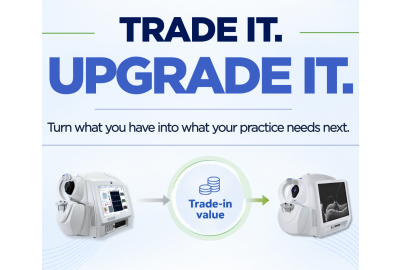
Your next equipment purchase may start with something you already own.
An OCT, retinal camera, autorefractor, topographer, visual field, slit lamp, or other ophthalmic instrument you are ready to replace may still have value.
Instead of treating older equipment as an afterthought, a trade-in can make it part of the financial plan for what comes next.
For practices planning an upgrade, expansion, remodel, or technology change, the business case is simple: your existing equipment may contribute toward your next investment.
At Next Vision Instruments, the conversation does not have to begin with a specific replacement product. It can begin with the equipment already in your practice.
From there, our team can help you evaluate potential trade-in value, compare New and Certified Pre-Owned options, and build an equipment plan around your clinical needs, workflow, budget, and long-term goals.
What Is an Ophthalmic Equipment Trade-In?
An ophthalmic equipment trade-in allows a practice to apply the value of qualifying existing equipment toward another equipment purchase.
Rather than purchasing a replacement system at its full acquisition cost and separately deciding what to do with the equipment being replaced, the existing system becomes part of the upgrade transaction.
This can be particularly valuable with higher-investment diagnostic equipment such as OCT systems, retinal cameras, visual fields, autorefractors, and corneal topographers.
The important point is that trade-in value is not determined by model name alone. Two units of the same model may have different values depending on their age, condition, configuration, software, accessories, and current demand. That is why the first step should be an individual equipment evaluation.
How Much Is My Ophthalmic Equipment Worth?
There is no universal trade-in value for ophthalmic equipment. A number of factors can influence what a particular system may be worth:
- Manufacturer and model
- Demand varies by brand, product category, and technology platform.
- Age and generation
- The market for one generation of an OCT, retinal camera, or other diagnostic platform may differ significantly from another.
- Operating condition
- A complete, functional system may be evaluated differently from equipment requiring repair.
- Cosmetic condition
- How well the equipment has been maintained can also matter.
- Software and licensing
- Certain diagnostic systems vary significantly based on installed software and licensed capabilities.
- Included accessories
- Tables, computers, printers, lenses, probes, cables, and other system-specific accessories may affect the overall equipment package.
- Service history
- Available service information can provide additional context about the system.
- Current market demand
- Ultimately, equipment value is also influenced by demand within the secondary ophthalmic equipment market.
This is why current photos and configuration details are helpful when requesting an evaluation. A model number rarely tells the entire story.
What Types of Ophthalmic Equipment Can Have Trade-In Value?
Trade-in opportunities are not limited to one category of equipment.
Depending on the individual model, configuration, condition, and current demand, practices may want to have equipment evaluated across a wide range of categories, including:
- OCT systems
- Retinal and fundus cameras
- Autorefractors and keratometers
- Corneal topographers
- Visual field analyzers
- Biometers and ultrasound systems
- Slit lamps
- Phoropters
- Lensmeters
- Tonometers
- Exam chairs and instrument stands
- Other diagnostic and exam-lane equipment
Next Vision works across both diagnostic and exam-lane equipment, with New and Pre-Owned options available across a broad range of product categories.
A trade-in does not necessarily have to lead to a one-for-one replacement. You may be trading an older diagnostic system while investing in a different area of the practice.
How Does an Ophthalmic Equipment Trade-In Work?
The process can begin with a few basic details.
Tell Us What You Have
Provide the manufacturer, model, condition, and any relevant configuration information for the equipment you are considering replacing.
Send Current Photos
Photos help show the equipment's condition and configuration and provide more context for the evaluation. Next Vision's equipment submission process allows practices to provide equipment details and images for review.
Have the Equipment Evaluated
The system can then be reviewed based on its condition, configuration, and current market considerations.
Compare Your Upgrade Options
This is where a trade-in becomes part of a larger equipment strategy. Depending on your goals, you may compare:
- New Equipment: For practices prioritizing current-generation technology, warranty, longevity, workflow, or newer capabilities.
- Certified Pre-Owned Equipment: For practices seeking proven technology at a lower acquisition investment.
- A Mix of Both: For practices that want to prioritize investment differently across diagnostic and exam-lane equipment.
Put the Trade-In Toward What Comes Next
If the equipment qualifies and you move forward with an upgrade, its trade-in value can become part of the overall equipment investment.
Not Sure What You Want to Upgrade To Yet?
That is okay. Start with what you already have. Our team can help you evaluate your current equipment and compare potential next steps.
Trade-In vs. Selling Used Ophthalmic Equipment
Selling used equipment and trading it in are related, but they serve different goals.
Trade it in
A trade-in is particularly useful when you are already planning another equipment purchase and want the value of your existing system incorporated into that next investment.
Sell it separately
Selling equipment separately may make sense when you simply have a system you no longer need and are not currently planning a replacement.
For a practice already considering an upgrade, the more useful question is often:
What can my current equipment contribute toward my next purchase?
That shifts the conversation from simply disposing of older equipment to planning the next investment strategically.
When Is the Right Time to Trade In Ophthalmic Equipment?
You do not necessarily need to wait until equipment stops working before evaluating an upgrade. A trade-in conversation may make sense when your practice is:
Outgrowing Current Capabilities
Your existing system may still perform its original function, but your clinical needs may have expanded.
Adding Patient Volume or Locations
A growing patient base, additional office, or new exam lane can change what your practice needs from its equipment.
Looking to Improve Workflow
Newer or different equipment may streamline steps, expand imaging capabilities, consolidate functions, or better support how your team works today.
Planning a Larger Equipment Refresh
If several systems are approaching replacement at the same time, looking at them as one equipment plan may provide more flexibility than replacing each system individually.
Comparing New and Certified Pre-Owned Options
Knowing the potential value of your current equipment gives you a better number to evaluate than purchase price alone: your expected net investment after trade-in.
New vs. Certified Pre-Owned: Where Should Your Trade-In Go?
There is no single answer that fits every practice.
New Equipment
A New system may make more sense when the practice prioritizes current-generation capabilities, warranty coverage, workflow, or a longer planned ownership horizon.
Explore new equipmentCertified Pre-Owned
Certified Pre-Owned may be the stronger option when the goal is to gain access to proven technology at a lower acquisition investment.
View pre-owned equipmentA Mix of Both
Sometimes the strongest solution is a combination of both, particularly when planning multiple equipment purchases, refreshing lanes, or expanding diagnostic capabilities.
Compare your optionsNext Vision operates across both New and Pre-Owned ophthalmic equipment, which allows practices to compare different acquisition paths rather than beginning with only one option.
That is especially valuable when planning multiple equipment purchases, building a new office, refreshing lanes, or expanding diagnostic capabilities.
Look Beyond the Purchase Price
Trade-in value is an important part of the business case, but it should not be the only consideration. Before choosing your next system, evaluate the full investment.
Estimate Your Net Equipment Investment
See how potential trade-in value changes the equipment investment you are considering.
Use the price you are considering.
Enter a planning amount or evaluated value.
Subtract the potential trade-in value from the equipment price to estimate your net equipment investment. Request an individual evaluation for a confirmed value.
Excludes taxes, shipping, installation, financing costs, and other charges. Final trade-in credit, eligibility, and purchase terms require review by Next Vision Instruments.
- Net Acquisition Cost
- What remains after potential trade-in value is applied?
- Clinical Capability
- Does the equipment meaningfully expand what your practice can assess, diagnose, document, or offer?
- Workflow
- Will the system improve how efficiently your staff and doctors work?
- Financing
- Would financing help preserve cash flow or make the equipment investment easier to manage?
- Equipment Lifecycle and Support
- What does ownership look like after installation?
- Growth Plans
- Will the equipment continue to make sense if the practice adds volume, services, providers, or another location?
Looking at these factors together is how a trade-in becomes part of a larger ROI and equipment-planning discussion rather than simply a discount.
Why Trade In With Next Vision Instruments?
A trade-in should not end with assigning a value to the equipment you are replacing. Next Vision can help with the broader equipment decision across:
- New ophthalmic equipment
- Certified Pre-Owned equipment
- Trade-ins
- Financing
- Delivery and installation
- Service
- Technical support
- Broader equipment planning
The goal is to help your practice determine what makes sense before, during, and after the equipment purchase.
Instead of approaching each part of the project separately, you can look at the entire decision:
- What equipment do we have now?
- What might it be worth?
- What capabilities do we need next?
- Should we buy New, Certified Pre-Owned, or a combination?
- How should we finance, install, and support the equipment?
That is the advantage of working with a complete ophthalmic equipment partner.
Frequently Asked Questions About Ophthalmic Equipment Trade-Ins
Can I trade in used ophthalmic equipment?
Qualifying ophthalmic equipment may have trade-in value depending on factors such as manufacturer, model, condition, configuration, software, accessories, and current demand. An individual evaluation is the best way to determine whether a particular system may qualify.
How do I find out what my ophthalmic equipment is worth?
Start with the manufacturer, model, equipment condition, configuration details, and current photos. Those details provide a better basis for an evaluation than the model name alone.
Can I trade in an OCT?
OCT systems can be evaluated for potential trade-in value just like other ophthalmic diagnostic equipment. Whether a particular system qualifies will depend on the individual unit, its configuration, condition, and current demand.
Do I need to know what I want to buy before requesting a trade-in evaluation?
No. You can begin with the equipment you currently own and then compare potential upgrade options based on your practice's clinical needs, workflow, budget, and goals.
Can trade-in value be applied toward Certified Pre-Owned equipment?
Next Vision offers both New and Certified Pre-Owned ophthalmic equipment. The best acquisition path can be discussed as part of your equipment evaluation and upgrade plan.
What information should I provide for a trade-in evaluation?
A strong starting point is the manufacturer, model, condition, relevant configuration details, and several current photos of the equipment.
Can I have more than one piece of equipment evaluated?
If you are planning a larger equipment refresh, expansion, or multi-lane project, discuss the full list of equipment with the Next Vision team so the opportunity can be reviewed as part of the broader equipment plan.
Trade In What You Have.
Move Into What You Need Next.
Your current ophthalmic equipment may still have a role to play in your next investment. Before you replace it, find out what it could be worth.
Whether you are upgrading an OCT, replacing diagnostic equipment, refreshing an exam lane, expanding an existing location, or planning a larger equipment project, Next Vision Instruments can help you evaluate what you have and compare what comes next.
What Could Your Equipment Be Worth?
Getting started is simple. Send us:
- Manufacturer and model
- Equipment condition
- A few current photos
- What you're considering next, if known


